What is a GCC Certificate?

Within South Africa, two variations of GCC certificates exist:

  • The initial type of GCC certificate is the GCC Factories issued by the Chief Inspector of the Department of Employment and Labour. This certification serves as a license bestowed upon mechanical or electrical professionals, empowering them to oversee machinery in compliance with the General Machinery Regulations.
  • The subsequent type of GCC certificate is the GCC Mines & Works (or GCC Mining), which is issued by the Chief Inspector of Mines within the Department of Mineral Resources and Energy. This certification functions as a license provided to mechanical or electrical individuals, enabling them to supervise machinery in accordance with the regulations outlined in the Minerals Act.

Individuals possessing GCC certificates are commonly referred to as Certificated Engineers. These certificates are specifically pertinent to mechanical or electrical engineers, technicians, or artisans employed within factories or mines in South Africa.

It's essential to note that the GCC certificate does not constitute a formal qualification. There are no registered qualification or unit standards acknowledged by either the South African Qualifications Authority or the Quality Council for Trades and Occupations associated with the GCC certificate.

What role does the GCC Factories certificate serve?

The GCC Factories certificate serves to confirm that the holder has fulfilled the criteria to be recognized as a Certificated Engineer. The term "Certificated Engineer" is defined within the General Machinery Regulations (GMR) and the Certificate of Competency Regulations, both of which stem from Section 43 of the Occupational Health and Safety Amendment Act.

Under General Machinery Regulation 2, it is stipulated that an employer or machinery user must designate a full-time individual for each premises where machinery is employed. This appointed individual is commonly referred to as the GMR 2 appointee.

The GMR 2 is tasked with overseeing the operation of machinery. Whenever the combined power output of machinery exceeds 3000 kW, it is mandatory according to GMR 2(4)(a)(ii) that the GMR 2 is a Certificated Engineer. Alternatively, the GMR 2 can be an individual holding a bachelor's degree, having passed the GCC Factories OHS Act exam, and possessing relevant experience.

Additionally, a GMR 2 must be appointed when the maximum demand surpasses 10000 kVA, specifically in cases where machinery is solely utilized for electricity distribution. This appointment requirement is outlined in GMR 2(5)(c). Alternatively, the GMR 2 must hold a bachelor's degree, have passed the GCC Factories OHS Act exam, and possess relevant experience.

The Department of Employment and Labour issues the following Certificates of Competency:

  • Certificate of Competency for Mechanical Engineer (Factories).
  • Certificate of Competency for Electrical Engineer (Factories).
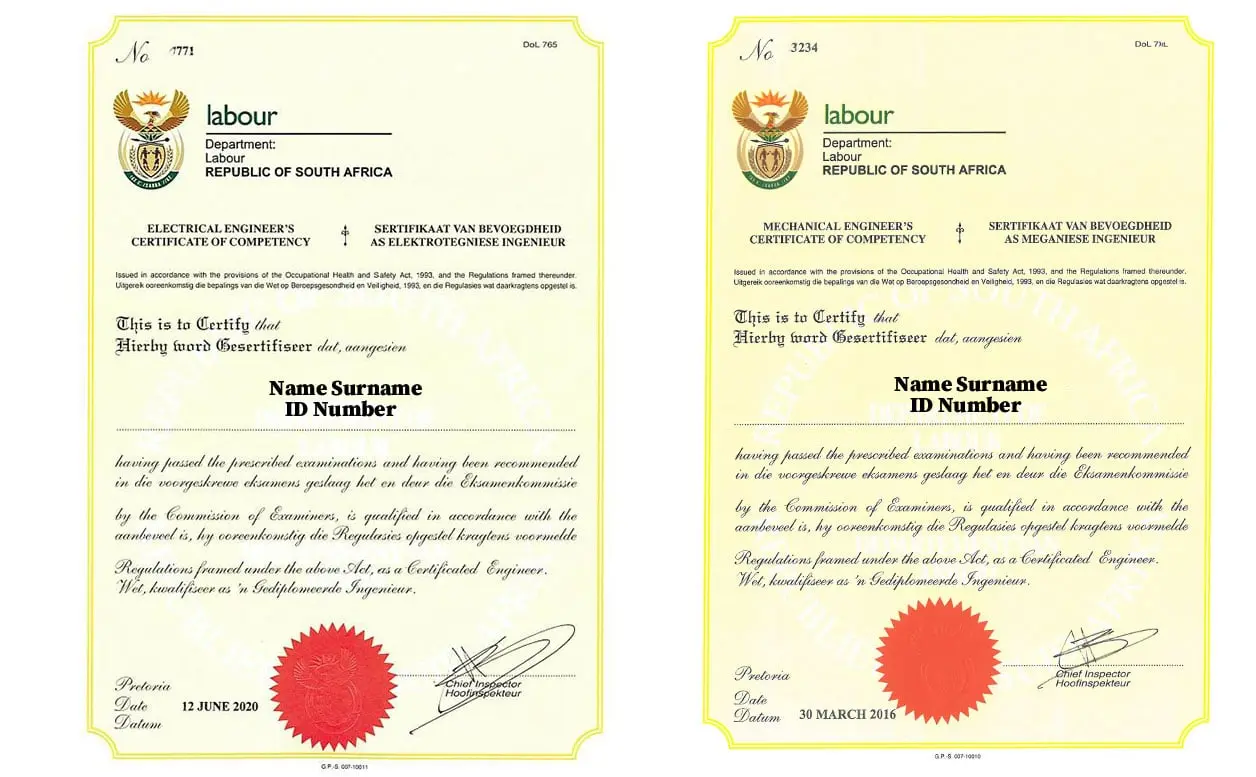
gcc certificates(factories)

GCC certificate examples (Right: Electrical GCC factories certificate, Left: Mechanical GCC factories certificate)

What is the purpose of GCC Mines & Works certificate?

According to the Minerals Act Regulation 2.13.1, an engineer needs to be appointed in writing by the mine manager whenever:

  • the rating of machinery used for power generation and from other power sources exceeds 2500 kW, or
  • there is an installation of any winding plant used to convey persons.

The 2.13.1 appointment is the common name used to refer to the engineer appointment.

The engineer (2.13.1 appointment) must be a holder of a mechanical or electrical engineer's certificate of competency (also referred to as GCC Mines & Works).

There are two types of GCC Mines & Works certificates:

  • Certificate for Competency as Electrical Engineer for Mines and Works
  • Certificate for Competency as Mechanical Engineer for Mines and Works
gcc mines

GCC certificate examples (Left: Electrical GCC Mines & Works certificate, Right: Mechanical GCC Mines & Works certificate)

Obtaining the GCC Factories certificate:

The process of obtaining the GCC Factories certificate typically involves five main steps, outlined below:

  • Step 1 - Fulfill the entry requirements for the GCC Factories exam.
  • Step 2 - Submit an application to take the GCC Factories exams.
  • Step 3 - Prepare thoroughly for the GCC Factories plant engineering & OHS Act exams.
  • Step 4 - Register for, take, and successfully pass the GCC Factories plant engineering & OHS Act exams.
  • Step 5 - Forward your statement of results to the Department of Employment & Labour.

The GCC Factories certificate is subsequently issued by the Chief Inspector upon recommendation from the Commission of Examiners.

Obtaining the GCC Mines & Works certificate:

The process of obtaining the GCC Factories certificate typically involves nine main steps, outlined below:

  • Step 1 - Obtain a letter of qualification evaluation from an accredited entity.
  • Step 2 - Request permission to commence training.
  • Step 3 - Acquire the 'Annexure E' handbook.
  • Step 4 - Secure a mentor in the engineering field.
  • Step 5 - Complete the 'Annexure E' modules under the guidance of the engineering mentor.
  • Step 6 - Apply to sit for the GCC Mines & Works examinations.
  • Step 7 - Prepare thoroughly for the GCC Mines & Works plant engineering and legal knowledge exams.
  • Step 8 - Register for, take, and successfully pass the GCC Mines & Works plant engineering and legal knowledge exams.
  • Step 9 - Submit an application to receive the GCC Mines & Works certificate.

The GCC Mines & Works certificate is issued by the Chief Inspector of Mines upon recommendation from the Commission of Examiners.

In Summary

The objective of this article was to provide a comprehensive overview of the GCC certificate. In essence, it outlines the two main types of GCC certificates available in South Africa: GCC Factories and GCC Mines & Works.

Both GCC certificates are legal requirements originating from legislation related to workplace safety and regulatory compliance in South Africa.

  • The GCC Mines & Works certificate is regulated by the Mine Health & Safety Act.
  • The GCC Factories certificate is governed by the Occupational Health & Safety Amendment Act.

Required Subjects For GCC Exam Read this article 
For more in depth info, please visit paulcraft website 

© Copyright 2025 Ultra-Deep All Rights Reserved